Did you know that your hearing is as unique as your fingerprint? Many factors determine the ability to hear, such as professional or recreational exposure to noise, age, and even medication use. It’s not unusual for individuals to experience a decrease in their hearing ability over time, although hearing loss can be harmful to your physical and mental well-being if left unaddressed.
Perhaps you can recall having a pure tone hearing test as a child in school. During a pure tone test, you will listen and respond to the beeps you hear while wearing headphones or earplugs. After the conclusion of your hearing test, you will be shown an audiogram that indicates your hearing health in each ear. The audiograms below show the results of normal hearing and hearing loss. For normal hearing, the line will be relatively flat in the range of 0 to 20 Decibels (dB). For a person with hearing loss, the steeper the slope of each line (signifying which beeps you did or did not respond to), the greater the degree of hearing loss.
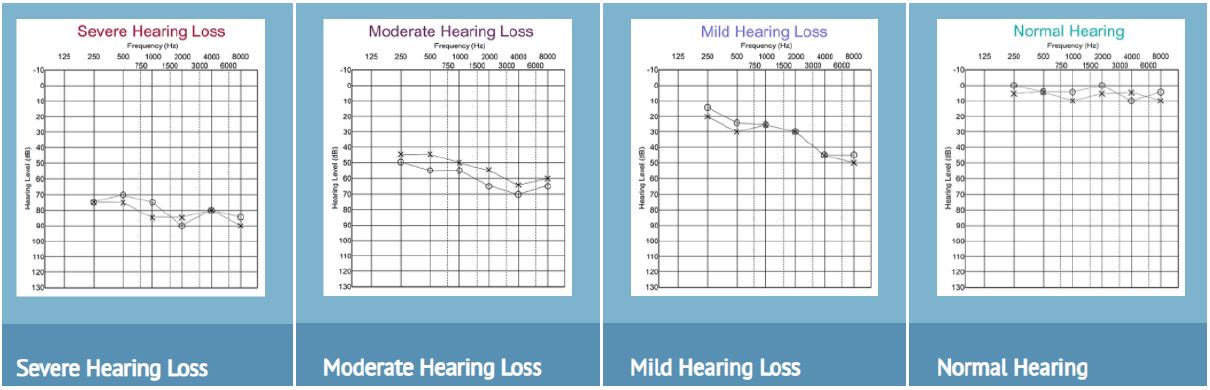
An audiogram doesn’t always reveal everything about your ability to hear. Additional tests such as a speech test, measuring your understanding of words with added background noise, and a bone conduction test, a measurement of how well the bones in your ear move sound vibrations to the brain, can also be conducted to fully determine your type of hearing loss and what treatment will be most effective. The World Health Organization recommends that all adults starting at age 50 should get a hearing test every five years, while those over 65 should have a hearing test ever one to three years depending on their test results.
If you are curious about your hearing health but not yet ready to visit a licensed professional, an online hearing screening can give you basic knowledge of how well you hear. However, the online screening does not replace the comprehensive hearing test provided by a licensed hearing care professional and we highly recommend that you schedule an appointment if the screening suggests that you have hearing loss.
If you have a mild hearing loss, that means you can hear most things but struggle to hear sounds between 26-40 decibels (dB).1 For example, it may be hard for you to hear whispers, water dripping, or birds chirping.
With a moderate hearing loss, you struggle to hear sounds between 41-55 dB. This means that phone conversations without a loudspeaker may be difficult, your TV volume may need to be turned up loud, and certain letters such as j, z, g, i, u, b, d, a, o, r, p, ch, sh, h, k may be lost to you.2
With a severe hearing loss, you lose out on sounds between 71-90 db, which may threaten your ability to hear conversation at normal levels, a phone ringing, a smoke detector, or your doorbell.
Being unable to hear sounds beyond 91 db signifies a profound hearing loss and speech identification is very difficult or inaudible.
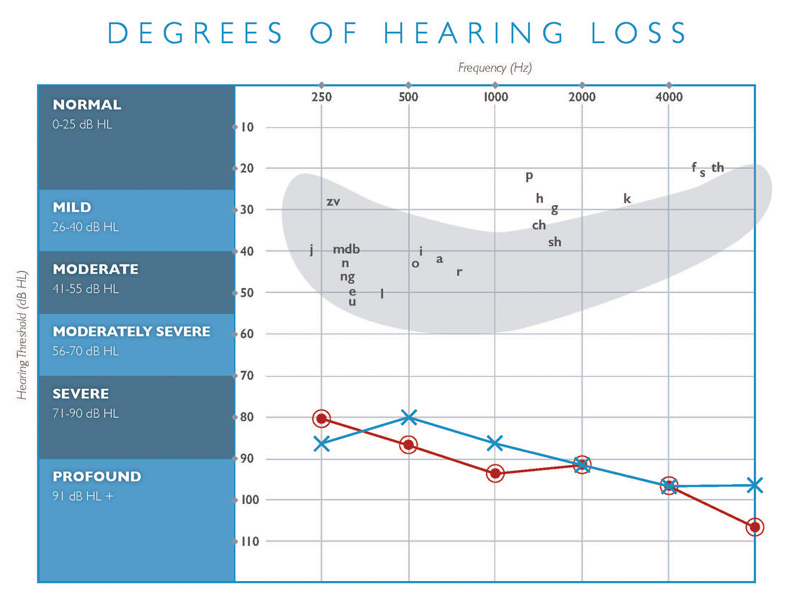
Hearing aids are an option for individuals with any degree of hearing loss. You can find hearing aids through a licensed hearing care professional at a wide variety of price points and the professional can adjust the hearing aids to your unique hearing needs. You can also find over-the-counter (OTC) hearing aids online that you can adjust on your own, but OTC hearing aids are only intended for those with mild to moderate hearing loss and you should be very cautious about purchasing technology online to ensure the devices will work as advertised. Review the helpful FAQ on OTC Hearing Aids before purchasing hearing aids online.
To take the first step toward treatment by getting a hearing test or if you have general questions about your hearing health or what technology would be most beneficial to you, be sure to contact a licensed hearing care professional.

The Hearing Industries Association is the trusted voice on hearing health care for product innovation, public policy, patient safety and education.


